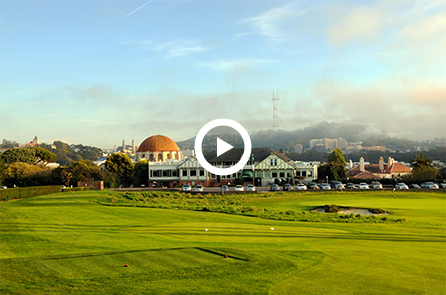
About Presidio Golf Course
Located within a national park, San Francisco’s Presidio Golf Course is renowned for its spectacular forest setting, as well as its challenging play. Once restricted to military officers and private club members, today the 18-hole course is open to the public. Presidio G.C. offers a full service restaurant, a driving range and practice facility, and an award winning golf shop that offers the latest in golf equipment and apparel. Presidio Golf Course is a contributing feature of the Presidio’s National Historic Landmark status. It is also notable for its environmentally sensitive management practices.
The Course
God shaped this land to be a golf course. I simply followed nature.
– John Lawson, designer of the first course
Presidio Golf Course is built on a variety of terrains. Holes are constructed over a base of adobe clay, rock, sand, or a combination of all three. The early Presidio Golf Course was short, but challenging. Players were often shocked by the level of difficulty and natural obstacles. Lawson Little, stamped by Golf Magazine as the greatest match player in the game’s history, said, “I have played the best courses here and abroad, but none more enjoyable than my home course of Presidio. I learned how to strike the ball from every conceivable lie. Presidio demands accuracy, but being a long hitter, I also had to learn how to hook or fade around trees. I had the reputation of being a strong heavy-weather golfer; well, Presidio has powerful wind, rain, fog, sudden gusts, and sometimes all four on any given round.”
Environmental Sensitivity
Presidio Golf Course has been recognized as a leader in environmentally sensitive golf course management, winning the 2001 “Environmental Leader in Golf Award”. Since 2000, the course has reduced overall pesticide use by approximately 50%, and currently uses approximately 75% less pesticide than private courses in San Francisco. The course also received certification from Audubon International as a partner in the Audubon Cooperative Sanctuary Program in 2003.
The course uses an innovative form of pest management and turf management called compost tea. “Compost tea” is a solution made by soaking compost in water to extract and increase the beneficial organisms present in the compost. It is then sprayed over the greens. The result is turf with longer root growth and less plant disease fungi.
Vixen.17.08.17.quinn.wilde.before.you.go.xxx.10... -
Furthermore, democratization of production tools has turned audiences into creators. High-definition smartphone cameras and cloud-based editing software allow independent creators to compete directly with multi-billion-dollar studios for consumer attention. User-generated content platforms dominate daily screen time, blending the line between professional entertainment and amateur documentation. Cultural and Social Impacts
Today, the industry has transitioned from a broadcast model to an algorithmic, decentralized ecosystem. The rise of high-speed internet and mobile technology dismantled geographic boundaries, turning localized media into global phenomena overnight. Key Trends Driving Entertainment Content Vixen.17.08.17.Quinn.Wilde.Before.You.Go.XXX.10...
In the 21st century, the landscape of is undergoing a profound transformation. What was once defined by passive consumption—watching a scheduled television show or buying a physical record—has become an interactive, personalized, and constant experience. From blockbuster films and streaming series to user-generated content on social media, popular media shapes our culture, influences our societal norms, and defines how we spend our leisure time. Cultural and Social Impacts Today, the industry has
However, the rapid proliferation of digital media also presents significant challenges. The algorithmic drive for engagement often prioritizes sensationalized or emotionally polarizing content, contributing to the spread of misinformation and the creation of echo chambers. Additionally, the constant availability of on-demand entertainment raises concerns regarding screen addiction, reduced attention spans, and the mental health impacts of social media consumption. The Future of the Media Landscape What was once defined by passive consumption—watching a
The subscription video-on-demand (SVOD) model fundamentally restructured the entertainment industry. Legacy Hollywood models relied on physical box office returns, syndication deals, and advertising slots. The modern digital paradigm relies on subscriber retention and lifetime customer value.